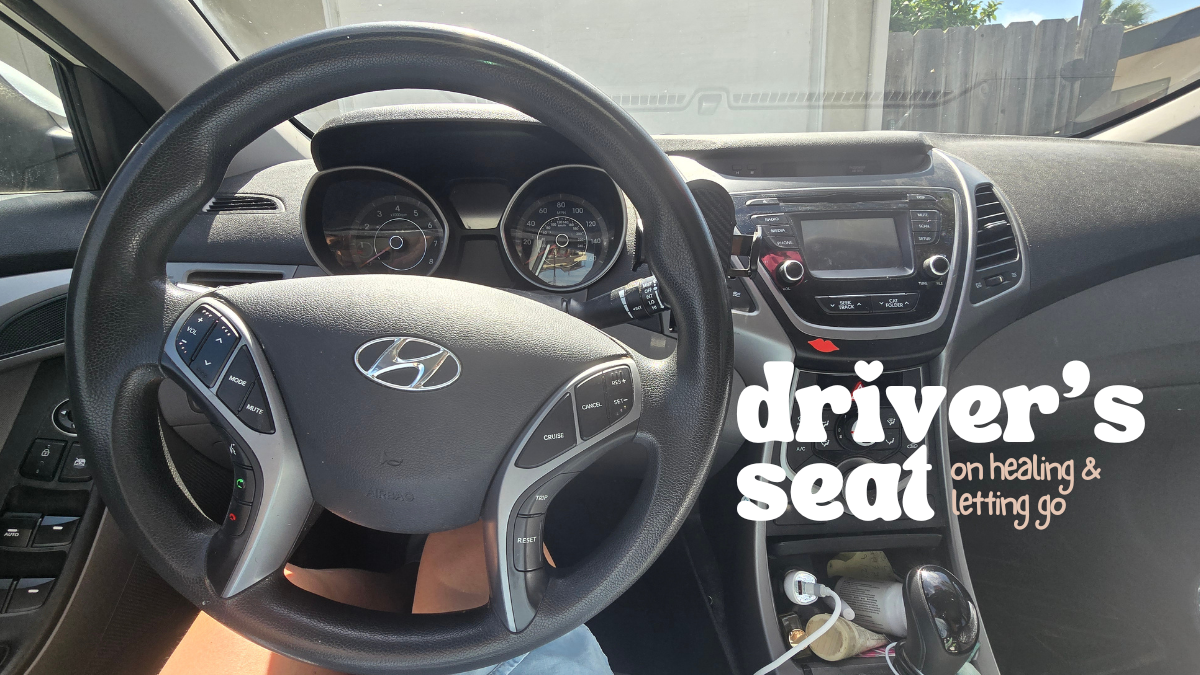
Regulate your nervous system. I remind myself of this as I slide into the driver’s seat of my car, take a deep breath before I turn on the ignition. I’ve spent the better part of a year teaching myself this—to breathe slowly and intentionally, to quiet my mind, to remember that in any given situation, there are so many things I cannot control. And it’s futile trying to.
The funny thing about healing is that you realize two very important things: (1) It is not a straightforward process, and (2) You will find yourself subject to the same lessons over and over and over again until you learn them.
I’m facing the latter (again). Somehow, I’ve found myself in an eerily similar situation to my last, and the one before, and the one before. The pattern traces back as far as I can remember.
Right now, I’m standing at the precipice of choosing to lean in or deciding to prioritize my feelings first. In every past moment, I’ve always chosen the former. It was far easier to do what I’ve always done—love with reckless abandon—and in the process, abandon myself.
But something about the urgency of this situation pulls at a deeper part of my core. It’s like my body is saying, Hi, I’m here. And you can’t ignore me this time.
In therapy, I’ve learned that this is intuition—a pull in your chest often misinterpreted as anxiety, or hesitation, or fear—and that I should trust it. I’ve come to recognize it as my inner knowing.
My body knows, maybe even before my mind does. My mind may register the instability, but my heartbeat has already accelerated. My chest has already tightened. My fingers are already clasped. For me, it manifests in rashes. Ripples of red that cross my chest and arms—an unconscious itch—telling me something isn’t right, even when I try to convince myself that it is.
When I think about where I am, on the edge of a decision that will either continue me on the same path or catapult me into a different stage of healing, I can’t help but wonder how I got here. If there’s something to be said for the recognition, if nothing else. If this is a part of the process, too: realizing that you’re farther along than you ever thought you’d be, even if in some ways you’re still running in circles.
Am I being dramatic? I put the keys in the ignition and listen to my car hum to life. The stability of that ten-year-old engine is a reminder that, despite the roads I’ve traveled—beautiful or difficult—there is something to be said for how I’ve always found my way through.
And maybe that’s what this is, too. Maybe not a grandiose lesson I’m supposed to learn, but a path I’m meant to drive along—a little less naïvely this time.
Breathe. I tell myself this again, and I intentionally suck in air, hold, and exhale deep and steady. There is something about the consciousness of breathing that brings you out of your head and into the present. Hands on the steering wheel. Foot on the pedal. Eyes on the dash. I realize that, despite the fluttering of my heart, there is one thing I know to be true: I will survive.
Not only this moment, this conversation, this confrontation, but the heaviness as a whole. Where I go from this moment—down a treaded path or on an entirely new route—will only continue to lead me to where I am meant to be, and perhaps more importantly, who I am destined to become.
Sometimes we say this, though, and the words fall short. They feel flat, a cliché that can’t quite capture the beauty of human connection, so it resorts to an empty catchphrase. And I’ll admit, I’ve used these words as a rationale many times. I’ve convinced myself to let go, believing that the release would bring what I wanted back to me. I’ve given myself the courage to walk away under the premise that what’s mine to hold will return to my arms.
Spoiler alert: I was wrong every time.
Perhaps that’s because those things weren’t meant for me.
But there was something about hanging onto those words that gave me the strength to keep going. Until I didn’t need that strength anymore. And I could finally release.
Is that wrong, though? Is it wrong to comfort yourself through the detachment process? To hold your own hand as you share uncomfortable truths? I don’t know if it is, unless it keeps you from really feeling the emotions you’re meant to feel.
So, as I steady my hands on the steering wheel, I remind myself that there are parts of healing you simply can’t avoid: the words you don’t want to hear or to say, the acknowledgement of patterns you’ve been resistant to or unable to free yourself from, and the decision-making that will break you regardless of which path you choose.
I put the car in reverse and glance in the rearview mirror—a reminder that even if we want to shift our focus to what lies ahead, there is always the importance of considering what came before—and I start to drive.
Where am I headed? I don’t quite know. All I know is that I’ve spent so much time trying to dissect subtle behavior shifts, facial expressions, or mannerisms; analyze potential outcomes of conversations before they even happen; and ruminate on hypothetical scenarios that become so anxiety-ridden they don’t even remotely resemble the truth. And that does nothing but pull me away from reality and into my head.
So, breathe. I whisper again. This is a reminder that grounds me, pulls me back to the present, and to the ground shifting beneath my feet. I may not always know how the path will look, what roadblocks may be present, what detours I may encounter on the way—but one thing is true—I will never not be in the driver’s seat.
And maybe one day, I’ll be merging lanes and see him doing the same: two drivers, two intersecting highways.
But this time, it won’t feel unsteady. We will be reflections of one another. Two souls with steady hands on their wheels, driving down a shared path.
Almost like coming home.